
A Practical Guide for Solo Agers Living and Aging Alone
Defining a Solo Ager Life on Your Own Terms
More than ever, older adults are embracing “solo aging” — the state of living alone without a spouse or partner and often without nearby family. According to recent research by the AARP, roughly 21% of adults aged 50 and older (about 24 million people) are now living alone. For many, this arrangement is a deliberate choice: the freedom to chart one’s own course, to enjoy autonomy, and to build a life that reflects personal desires rather than traditional expectations. But at the same time, this shift poses questions about support, connection and practical planning — particularly for people over 50 who find themselves aging without a spouse or family nearby. SoloAgersConnect decided to dig into this a little bit more.
The Bright Side of Freedom, Identity, & Purpose
One of the standout themes here is how many solo agers view their status as empowering. Having the ability to make decisions independently — from how they spend their time to how they manage their homes — is often cited as the benefit of living alone. For example, in a survey of adults age 50 to 95, about 35% said that freedom and autonomy are the best parts of living alone. These findings reinforce the message that aging alone isn’t necessarily about loss or loneliness. It can be about embracing your own life. In fact, many individuals who live alone report good physical and mental health, report strong social lives, and say they feel control and contentment.
The Realities of Challenges to Face Head-On
Solo aging isn’t without its concerns. One of the most common worries is losing independence. The possibility of needing help in the future for health issues or daily living, without a partner or nearby family to rely on is worrisome. In survey responses, 68% of solo agers expressed concern about becoming reliant on others; 62% worried about a decline in physical health; and 50% were concerned about cognitive decline.
Financial security is also more acute when you are solo. Without a partner’s income, shared retirement savings, or shared expenses, solo agers may face more vulnerability. Over half of respondents ages 50 to 64 said their financial situation was fair to poor. Finally, despite the freedoms, loneliness and isolation are real. The absence of a partner or children nearby can make social connections harder to create and maintain. Need some guidance to map out how your financial priorities align with your desired lifestyle? Take this quiz courtesy of our service provider, Beth Duffy, of Edward Jones.
Building the Support Network You Didn’t Expect
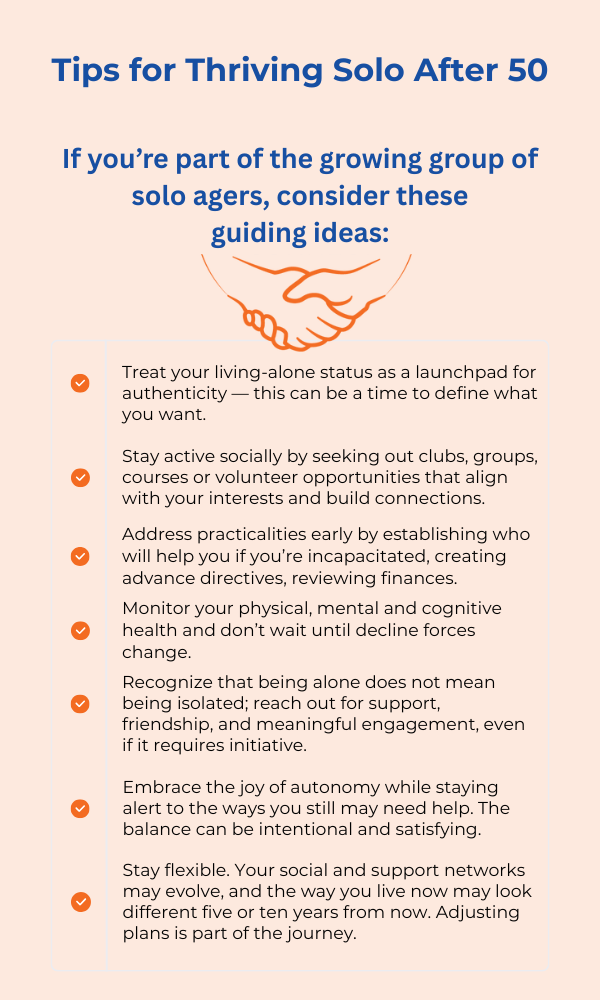
If you are aging alone, one of the most important strategies is to think intentionally about your social, practical, and financial support systems. Living alone doesn’t automatically equal isolation. Many solo agers successfully create a “family” of friends, neighbors or community members who form the backbone of their support system. Cultivating meaningful friendships, exploring community groups, volunteering, and staying connected to shared interests are all effective ways to feel engaged and supported even without a spouse or children nearby. In addition, planning ahead for things like legal documents, medical directives, and who to turn to in a crisis is critical. You can take charge of your later-life options now, rather than leaving them to chance later on. Visit our Events page for in-person events to meet locol solo agers or attend presentations or webinars on topics like decisions around housing, finances, and estate planning.
Solo Living Summary
Aging without a spouse or immediate family nearby is increasingly common. For many, it is a rich and wholly satisfying way to live. At the same time, it requires foresight, connection, and deliberate action to manage vulnerabilities and ensure well-being. As you move forward, remember that choosing a life on your own terms does not mean you must go it entirely alone. With planning, community, and self-understanding, solo aging can be not just manageable but meaningful and empowering.
SoloAgersConnect.com is an informational website designed to meet the needs of Solo Agers. In addition to finding information, resources, and trusted service providers, solo agers can connect with in-person events to build community and meet like-minded local solo agers. Visit our website to learn more.
The data shared in this blog is from the November/December issue of AARP magazine, which focuses on solo agers. Visit AARP online here.
About the Author
This article was written by Jill Kovalich, founder of SoloAgersConnect. Meet Jill, learn more about the journey that led her to create this online informational hub for solo agers. Do you want her to write about a certain topic? Send a message using this link to our Suggestion Box.
If you found this article helpful, please share this with a friend and be sure to sign up to receive our newsletter !
Help us Build Our Solo Agers Community!
SoloAgersConnect.com is an online hub for solo agers (also known as elder orphans) to easily locate a curated list of trusted service providers, information, resources, and events they need to connect with help and find similar people to build community and develop friendships.
If you found this article helpful, please share this with a friend and be sure to sign up to receive our newsletter !
Be sure to find us on Facebook and join the Solo Agers Connect group. Let’s grow our community, share information and resources, and build community and friendships.